The strike
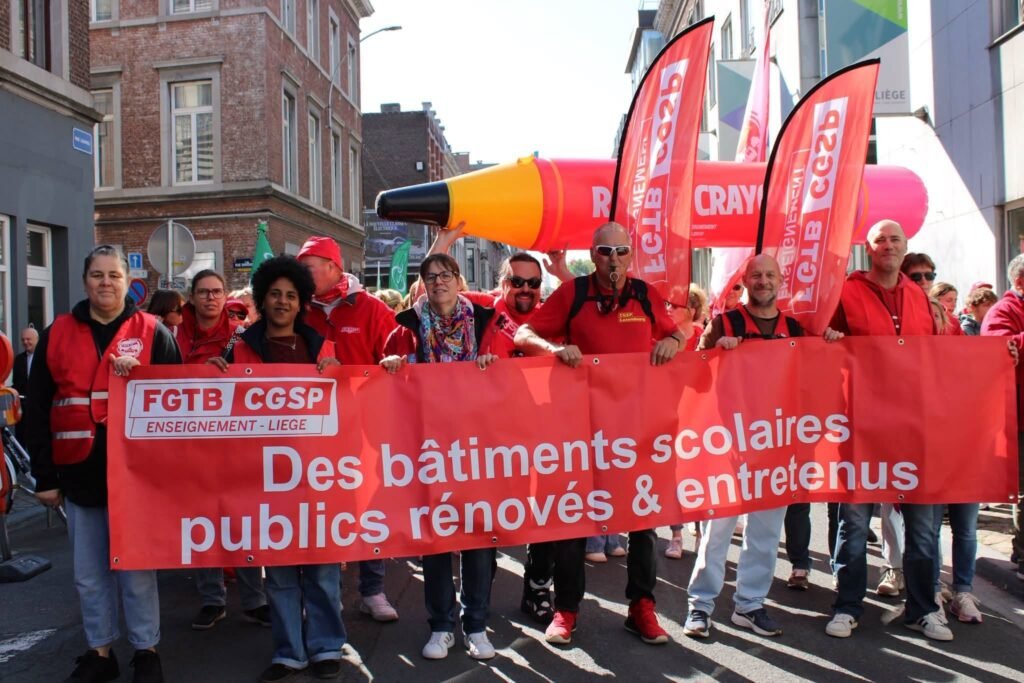
On Thursday 10 September at the station in Liège, thousands of demonstrators gathered to protest against cuts in French-speaking education. Amongst the demonstrators were striking teachers, students, pensioners and even Flemish teachers showing their solidarity.
Government cuts in French-speaking education are estimated to cost around 2,000 full-time jobs. But how are we meant to resist these measures? Our education commission talked with a teacher and CGSP/ACOD member from Liège to get answers.
Interview
Why are you striking today?
Our strike is aimed against the entire policy of the MR-engagés government at the level of the French-speaking Community. Under the guise of a debate on the budget, this is an ideological attack on the possibility of emancipation through school and education.
What is the effect of their policies on the quality of our education, and how does this affect the lives of both teachers and students?
There are various reforms and measures that affect us and pupils, particularly those from disadvantaged social backgrounds. For example, last year’s governmental decision on the NTPP; the number of teaching hours for teachers in function based on the number of pupils in a school. Technical schools (TQ) and professional schools (P) had their NTPP reduced by 3% in order to align with the NTPP of general schools.
We know that our pupils in the TQ and P schools need more attention. This had a twofold effect: we lost colleagues and our classes became overcrowded. As a result, our working conditions deteriorated. Furthermore, the government decided to close certain courses at 7 TQ and 7 P schools, forcing pupils to end their formation. Which in turn also led to us losing more and more colleagues.
How did the government try to justify these austerity policies?
The minister said that these courses would pass into ‘social promotion schools’, but it usually turned out differently. Although I am certain that these social promotion schools would not have put an end to capitalism, for some people they were a way to escape their circumstances and develop themselves. Now it has been given a new name: ‘adult education’, and the courses must be tailored to the needs of the market. This means many courses are being discontinued.
The government even wanted to abolish our Act, which protects us from political interference but also defines our role as a public service. Abolishing the Act and introducing contracts (of a fixed duration) will offer us neither stability nor protection against political interference. What’s even worse is that these contracts introduce a focus on targets and performance. This makes the managerial thinking of these bourgeois governments even clearer.
Our buildings are so outdated that they have become unsuitable for teaching in decent conditions. But instead of providing funds for renovation, the government has cut the grant for the buildings.
The government tried to divide us by extending the timetable for ‘high school teachers’ by two hours, to bring it into line with that of our colleagues in middle school.
What is the result of these two extra hours?
This has had several negative consequences: these extra 2 hours are unpaid, and adding 2 hours to a full-time timetable of 20 hours – bringing it to 22 hours – means that for every 10 teachers, we lose one colleague. It also means that we have to do the same amount of work with fewer colleagues and therefore with more pupils per class. Many colleagues’ timetables are spread across different schools, or we divide the same lesson among different colleagues. For example, pupils that have 5 hours of French per week might have 2 or 3 different teachers for those lessons.
You said the reforms targeted lower-income families. How does all of this affect them?
The decree organising “free schools” was also extended, allowing the schools themselves to determine who needs help. As a result, in nursery or primary schools, free evening meals are either no longer provided or reduced, while it is known that some pupils don’t eat at home.
Finally, the full tuition fee now stands at around 1,200 euros for universities and colleges. Previously, it was 835 euros for university, but at some colleges in particular it was 175 or around 300 euros. The main consequence, therefore, is that many pupils, particularly those from lower social backgrounds, will have no chance of studying in higher education.
Looking back on today’s strike, what is the way forward to overcoming these problems?
Today there was a sizeable mobilisation of around 15,000 people, according to the unions. But what we need in the coming period is to force the trade unions to put in place a strategy for the struggle, with a unity of action, a coordinated and organised plan and tactics.
To do this, we have the following work to do within the trade unions:
1) Let’s move beyond the budgetarian debate and further advance the ideological debate. What sort of schools do we truly want and do the pupils need? For this, we can use the CGSP-ACOD charter to develop a vision for an emancipatory school.
2) We must put forward our demands (fewer pupils per class, reinvestment in education). Merely reacting to attacks by the government is the wrong approach, as we then keep on “forgetting” earlier attacks, whilst each government will keep on planning new ones.
3) We must channel the justified anger of our colleagues and pupils into political objectives.
4) We must organise and coordinate our actions (and, where possible, extend them to Flanders and to an inter-professional level).
5) We must look to and exchange experiences with the education movements in other countries. In particular in Spain and France where last year the CCOO Educación organised many strikes, as did CGT Éduc’Action. Teachers and pupils all over Europe are facing the same problems.
Our way forward
Whilst our governments attack the working class and its achievements, our class is kept divided and fighting among itself for scraps. The struggles of education in the French and Dutch Community have yet to form a strategy that can turn the tide in favour of the teachers and pupils. We must overcome the budgetarian debate and advance the class struggle; for this, the working class and its youth, needs its own organisation.
Our education commission analyses the situation within education in Belgium. Their work gives our members within education guidance to intervene in the union struggle and build ties among pupils, students and the working class. Through our base units, our members can exchange experiences and get organised at their schools and universities.
As stated before, the problems within Belgian education aren’t isolated. They are deeply rooted within imperialist capitalism, Europe’s militarisation efforts and austerity measures to compete on a global market. Our International Commission exchanges experiences with Communist Parties and Youth involved in the education and union struggle in their respective countries. In this spirit, we would like to recommend to all our pupils the text “What kind of school do we need today?” by the Communist Youth of Greece https://int.kne.gr/publications/what-kind-of-school-do-we-need-today/ (available on paper at your nearest base unit).
Socialism is the only solution, get active in the run-up to the Second National Assembly of the JCB!
Here’s to a combative school year and the strikes on 9 October and the week of 23 November.
- Photo by CGSP/ACOD Education