A look back on the national protest of 9 October
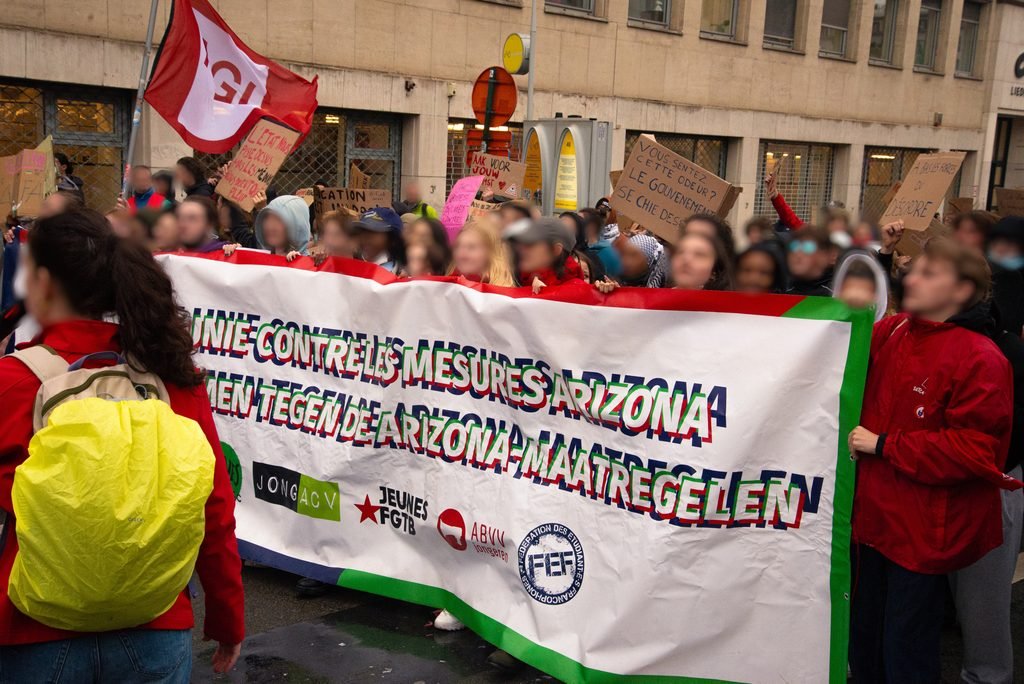
For almost two years, the two largest Belgian trade unions, the ABVV-FGTB and the ACV/CSC, have been taking action against the Arizona government coalition. The Great Polling, taken by several news organisations, shows that people are losing more and more trust in the ruling parties. Parties on the edge of the political spectrum – namely the PVDA-PTB and Vlaams Belang – see their percentages on polls grow. It is all too clear that a great part of the Belgian population is unhappy with the way things are. That’s why it’s no wonder that on the 9th of October we saw 30.000 to 50.000 people show up in Brussels to protest against the Arizona coalition. On a rainy friday, trade union members and workers, together with students, showed up in the capital for a decisive protest. This protest did not go as hoped, however.
First of all, the date of the protest was an unfortunate choice. Two days later, on the 11th of October, would be the day of the climate march in Brussels. The trade unions decided to participate in this government protest as well. The total participation on the 11th sat between 45.000 and 60.000 – a greater amount than on the 9th. By concentrating organizational resources on two mass protests in one weekend, the trade union leadership partially neglected the protest of the 9th of October.
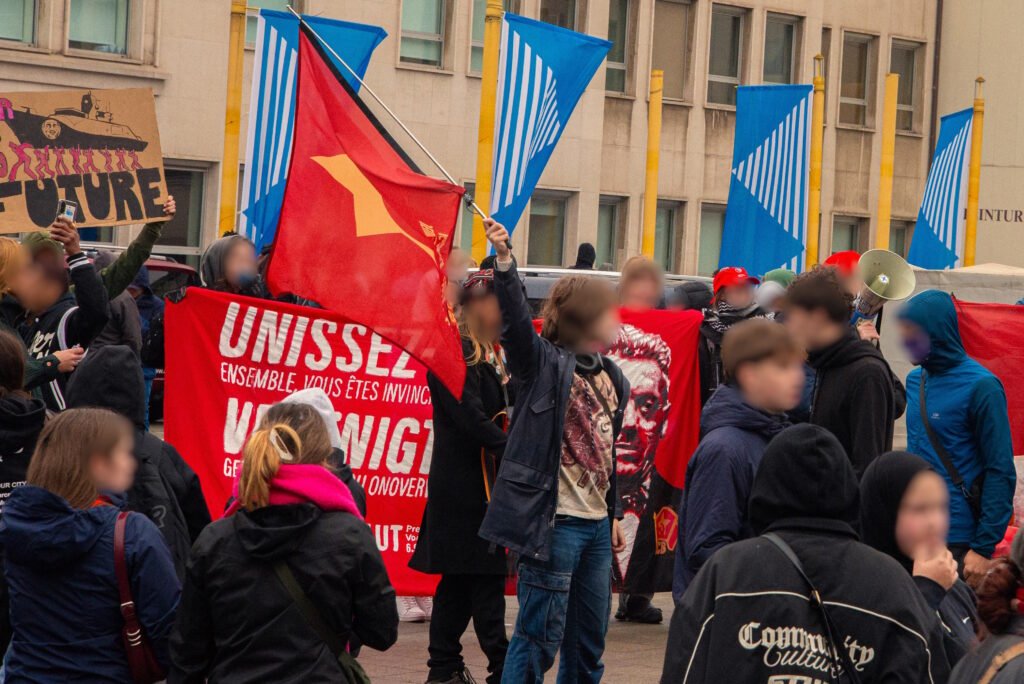
After the violent escalations during the school struggles in Liège it was not difficult to predict that the protest of the 9th would escalate. A portion of the furious youth, unorganized, alienated by bourgeois society, sought refuge in acting on that anger whichever way seemed possible. The trade union leadership was nowhere to be seen in this situation. There was one speaker armed with a microphone who hoped to calm the situation, long after the confrontation with the police had escalated. A great amount of young people, many of whom were simply spectators in the ‘riots’, were stuck in confrontation with the police while the trade unions marched through the streets of Brussels with heads held high.
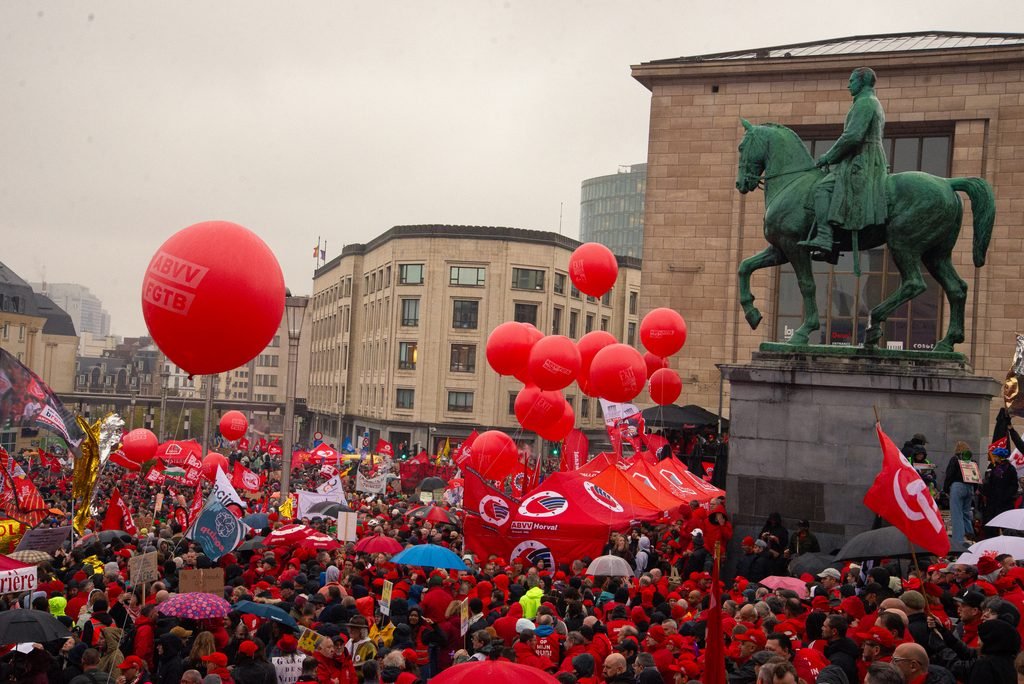
The lively trade union movement which has struggled for almost two years against the government budget has much room to grow. The trade union leadership, stuck in the way of thinking of the labour aristocracy, only knows how to beg for some crumbs from their employers. The leadership of the ACV/CSC even designed its own government budget to reduce the deficit! These trade union leaders – far removed from the mindset of the workers they represent – only dare to enter negotiations with the exploiting classes. According to them and each party in parliament there is no escaping capitalism’s logic. There simply have to be savings!
The JCB does not agree with such notions. The debts which the Belgian state collected for years, by lowering business tax and spending billions on subsidies, are not the debts of the workers. The working people of Belgium do not control the state. They do not control the economic life of Belgian society. Why do they have to concern themselves with a budget for a society which is not theirs? While bourgeois ruling parties – parties of the bosses – negotiate with each other and continue working themselves into a dead end, the next capitalist crisis looms closer and closer. As long as the working people do not commit themselves to class struggle and remain stuck in negotiations with the class that exploits them, they will be the ones to carry the majority of this crisis.
The trade union leadership does not dare to ask more than an alternative budget, a rich tax, a wealth tax. The slogan of class struggle, of irreconcilable war against the bosses, is not yet the order of the day. And this will never happen while the working class does not recognize itself as a class and only recognizes itself as one of the partners in the social partnership. While the trade unions remain stuck in this strategy, the bosses strengthen their attacks on the working people.
While social insurance under capitalism does not give us any insurance, we have to react more strongly against these attacks and protest our hard won rights. It is not through social dialogue that the working people realize their true power. The working people can only realize their true power from the work floors, from the schools and on the streets. Every struggle for reform – for better wages and pensions – has to heighten the class consciousness of the working people, and strengthen their organization as one force. We will never get any further if we continue fiddling at the margins and do not dare to decouple ourselves from the logic the bosses impose on us.
This is not merely a Flemish, Wallonian, or Belgian struggle. The European Union restricts budget deficits to 3%, while NATO requires us to increase our military spending. Trade unions in France join together with the protesting youth in solidarity. Spanish workers come out on the streets against rising housing costs. Everywhere in the world people are gathering, consciously or unconsciously, for one and the same struggle. This class struggle has an international character.
Let’s be strong together in this fight! Combine the fronts of workers and students into one, against Arizona, against Glatigny, against Demir, against capitalism! No more fiddling in the margins!