
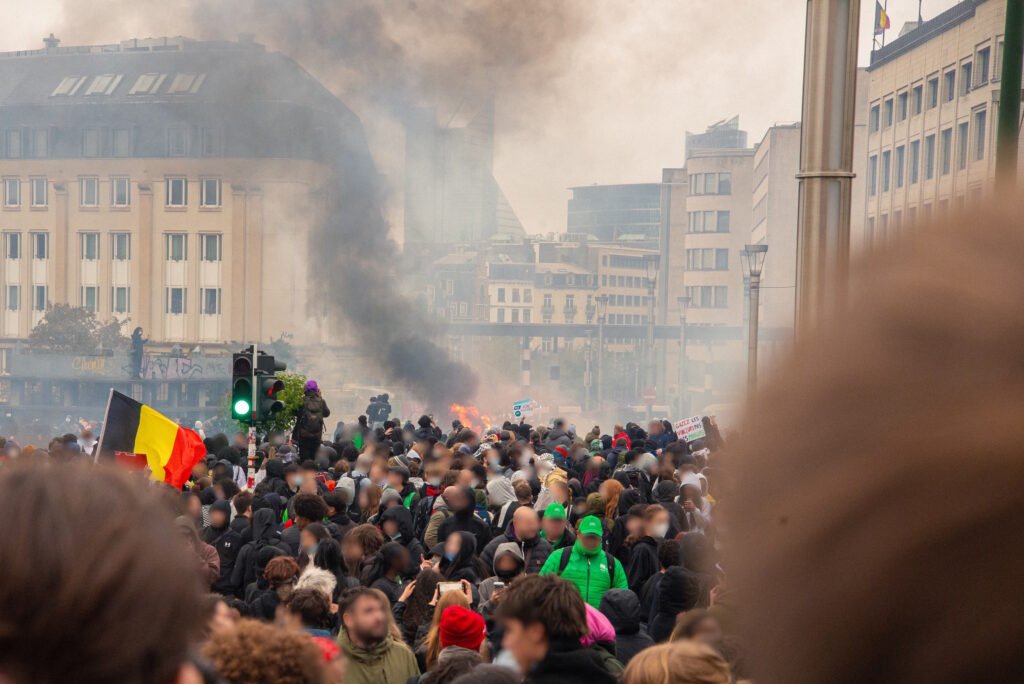
Overcrowded classrooms, exhausted teachers, classrooms that are freezing cold in winter and sweltering hot in summer, buildings that are literally falling apart; these are the problems that have been driving masses of French, Walloon and Brussels school pupils onto the streets since the start of the month. The youths’ demands are clear: enough with austerity; they want a future, and that future must begin with high-quality education.
Instead of listening to the students’ demands to put an end to austerity measures and invest more in education, the bourgeois governments of France, Wallonia and Brussels are responding in the only way they seem to know how: police repression. Heavily armed gendarmes beating minors with batons and shields, a police officer putting a 14-year-old girl in a stranglehold, crowds of young people being driven away with tear gas and water cannons, a 15-year-old losing a hand due to a flash grenade – as usual, the police show no mercy. They claim it is a response to the pupils’ violence; they must prevent these ‘rioters’ from wreaking havoc and making the streets unsafe. Apparently, it is more important to protect private property than to safeguard the future of young people.
But let us be clear: the pupils do indeed use violence during their protest; they start small fires and throw fireworks at the police when they charge at them. But the violence perpetrated by the pupils is of a different nature to that of the police. The pupils’ violence is the violence of the oppressed and the voiceless. Firstly, they are defending themselves against the presence of a militarised police force that itself provokes and creates pretexts to justify violence. And secondly, they are seeking a way to be heard. Young people are rarely taken seriously when they fight for their rights. If a pupil takes to the streets, they are seen as an opportunist who just wants to skip a day’s school and cause a bit of a ruckus! If you are not taken seriously by any peaceful means, why should you hold back?
But of course, you won’t hear this side of the story in the bourgeois media. They uncritically repeat the narrative put forward by the police, which talks of a ‘proportionate response’ to ‘rioters’ or ‘masked Antifa infiltrators’ who provoke officers and wreak havoc for no reason. It’s a neat narrative that distracts from the real reason why these young people are taking to the streets. This is, of course, hardly surprising; under capitalism, the media remains a tool for endlessly vilifying anything that opposes the system. What is surprising, however, is that trade unions and social-democratic parties are largely adopting this narrative.
Young people turned out for the socialist trade union’s national day of action on 9 October. Trade unionists took to the streets that day to voice their dissatisfaction with Arizona’s austerity measures; their opponent is therefore the same as that of the school pupils. As usual, the police were present in force, heavily armed, and sought confrontation with the young people. This provoked a reaction, which ended in repression and destruction. The trade union leadership immediately did their utmost to draw a distinction between violent rioters amongst the young people – who were there solely to smash things to pieces – and the law-abiding trade unionists, who had come to politely ask the government not to make too many cuts and perhaps even to introduce a millionaire’s tax. The response of the Belgian trade unions to the police repression stands in stark contrast to that of the French trade unions. In France, the trade unions are standing between the school pupils and the police. Teachers, firefighters and the ‘yellow vests’ are protecting the young people and showing solidarity. What began as young people’s dissatisfaction with the state of their education has grown into a militant popular movement making it clear that enough is enough when it comes to austerity.
In Belgium, we must draw inspiration from the actions of the French trade unionists; they recognise that the anger of young people, in all its forms, is justified. They recognise that their opponents are the same and that their struggles are inextricably linked. “La CGT avec les lycéen-nes, Leurs revendications sont légitimes”, “The CGT supports high school students; their demands are legitimate”. That is one of their slogans; let us take it to heart and ensure no rift develops between young people and the trade unions. It looks as though the struggle will rage on for some time yet, and this will teach young people important lessons. On the one hand, practical lessons in how best to organise themselves, but also theoretical lessons. The struggle for better education does not end with stopping cuts; it does not end with extra subsidies or a millionaire’s tax. These are merely temporary solutions, concessions from a bourgeoisie that does not want the true root of the problems to be addressed: the capitalist system.