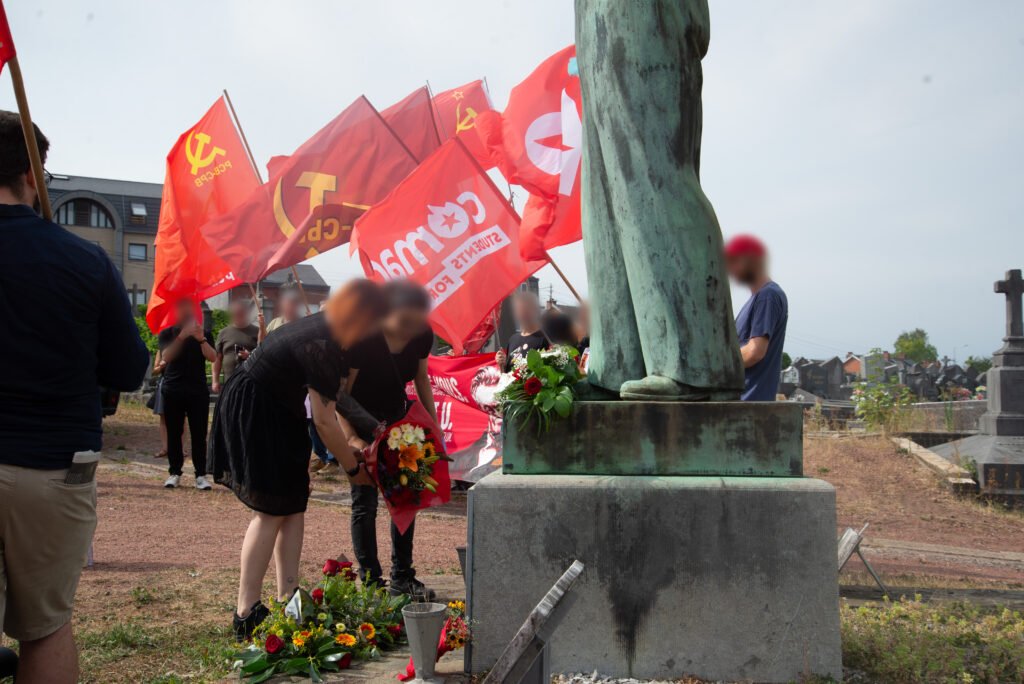
On August 16, 2026, we—the Young Communists of Belgium from various provinces and the Communist Youth Movement (CJB) of Dutch Limburg—gathered in Seraing to commemorate the murder of Julien Lahaut.
Seventy-six years ago, the then-chairman of the Communist Party of Belgium (CPB) was cold-bloodedly murdered by Belgian capital. We commemorate his contributions to the international working class, which made him an enemy of the Belgian state and its ruling class.
Lahaut’s Legacy
Lahaut’s oratorical talent inspired countless workers to take action and go on strike. Thanks in part to him, the CPB grew its working-class base in the 1930s and was able to play a leading role in strikes. Under his leadership, the CPB mobilized thousands of people to fight against fascism during the Spanish Civil War.
The CPB knew that the electoral struggle alone could not defeat fascism. Its trade union action committees, revolutionary youth organizations, and the armed resistance of the partisans were able to effectively resist fascism. A few months after the CPN in the Netherlands sparked the February Strike, Julien Lahaut led the Strike of the 100,000 in May 1941 in Belgium. The unity of the workers halted Belgian steel production for Nazi weapons. The occupying forces and the bourgeoisie were forced to increase rations and wages by 8%.
In June, he was arrested by the Gestapo and eventually deported to Neuengamme concentration camp. There, he earned the nickname “the man with the sun in his pocket who gave a piece to everyone”. Even in captivity, he organized communists and carried out acts of sabotage. He was deported to Mauthausen, where he managed to escape death despite his illness. After the liberation in the spring of 1945, he returned to Belgium, where he was welcomed as a hero and awarded the title of president of the CPB.
King Leopold III also returned after the war. Through years of resistance, the communists had won the trust of the Belgian working class. They greeted the king’s treason by calling for a Belgian republic. After several deadly demonstrations, Leopold III was forced to abdicate. When his son Baudouin took the royal oath, the communist faction shouted, “Long live the republic!”.
One week later, on August 18, 1950, Lahaut was murdered at the entrance to his home.
The Kingdom of Belgium during the Cold War
For its resistance during the war, the CPB was nicknamed “the party of the executed.” However, it failed to convert the widespread popular support after the war into a revolutionary situation or to maintain that support. The party relied too heavily on the bourgeoisie’s promises of welfare and social dialogue. The CPB decided to join the bourgeois government and abandoned its historic task and role as the vanguard of the working class in favor of the “peaceful road to socialism.”
But despite its participation in the government, the party remained in the crosshairs of NATO and its underground Gladio network. The party defended the achievements of the Soviet Union against attacks by bourgeois forces, and it also remained a driving force in progressive movements and the trade union movement. After World War II, the CPB stood in solidarity with national liberation struggles against colonial and imperialist domination.
Lahaut’s assassination can only be understood within this international context. Belgian capital—the bosses of the steel and mining industries—wanted to maintain their share of the world market. They had a vested interest in the establishment of NATO and the preservation of control over the Congo so they could exploit its raw materials and labor force.
Exactly one month after Lahaut’s assassination, the Belgian army trained 3,000 people for intervention in the Korean War. The Korean people had fought against Japanese fascism and their own oppressors. The national liberation struggle of the Democratic People’s Republic of Korea and the Workers’ Party was met by the imperialist powers with a war of apocalyptic proportions.
Likewise, when the Congolese people demanded independence from Belgium, the capitalists of Belgium and the U.S. resorted to bloodshed. Patrice Lumumba, leader of the independence movement, was murdered by their henchmen. Two teeth were the only remaining trace of Lumumba.
Decades later, the trail of evidence surrounding the murder of Julien Lahaut led to an anti-communist network linked to state security and NATO’s anti-communist Operation Gladio. Throughout the Cold War, this network would claim the lives of countless communists and union activists.
What can we learn from this?
Imperialist capitalism is once again driving us toward a global conflict. The technological developments of recent decades create new opportunities, but also present additional challenges for communists. Although it is easier than ever to spread propaganda, it has never been easier for intelligence agencies and employers to trace political affiliations.
Once again, the working class must strengthen its power by organizing within the companies and institutions in which they work. We emphasize that, as a communist, your safety is also the safety of the collective; of your colleagues and comrades, of your friends and family. The “party of the executed” teaches us that security measures are necessary for organization under conditions of increasing repression, militarization, and the threat of war.
The murder of Lahaut reminds us that capitalists are willing to let our class comrades die for their interests. It shows that the working class must build an independent force against the bourgeoisie and needs its own revolutionary organization. This organization must not base its strategy on the false promises of the bourgeoisie. Neither on those of the Belgian capitalists nor on foreign capitalist countries promising to counter imperialism by a “multipolar world order.” That is why we are independently building the Communist Youth and laying the foundation for a new Communist Party of Belgium.
The only way forward is the class struggle; only socialism can defeat imperialism.
In the words of Lahaut: “Unite, for together you are invincible!”